An assembly takes away one class period. Another section meets as usual. A third arrives late after a field trip. By the next rotation, the same grade is working at three different points in the same lesson.
For a specials teacher, the planning problem is keeping a shared lesson sequence usable while remembering where each class actually stopped. A practical approach is to keep the lesson plan and the class exceptions separate.
Start with a lesson sequence that survives a missed day
Write the learning goal and the lesson in a few recognizable steps. For an art lesson, those might be: observe examples, watch the demonstration, practice the technique, develop the artwork, and reflect. In music or PE, the steps will differ, but the principle is the same: give each stage a name you can recognize quickly.
Keep that sequence in your shared grade or course plan. Treat the scheduled meeting as an opportunity to move through the sequence, rather than assuming every section will reach the same step on the same date. You can still record dates for preparation, events and deadlines without making the date the only clue to what comes next.
Record the exception while it is still fresh
After an interrupted class, write three things: the last completed step, what changed, and the next action. You do not need to rewrite the entire lesson for each section.
Consider this hypothetical example: Class A misses an art period for an assembly, while Class B finishes the technique practice. Class A’s restart note could read, “Begin demonstration; examples already discussed.” Class B’s could read, “Start artwork; review how to load the brush before students begin.” Both classes still use the same lesson sequence.
“Assembly” explains why a class is behind, but it does not tell you how to teach the next period. The restart instruction is the part that turns the note into a usable plan.
Choose the next step before the next class arrives
When a section has less time, decide which part of the lesson matters most for that meeting. A demonstration and a short practice may be more useful than rushing into a larger task that students cannot finish safely or meaningfully.
When a section is ahead, choose a purposeful extension tied to the same goal. For example, students might compare two approaches, explain a choice, or refine an earlier attempt. These are teaching options to adapt to your subject and students, rather than reasons to move every other section forward prematurely.
If classes need to meet a shared deadline, identify the essential learning steps first. Then adjust the amount of practice, scope of the task or optional extension deliberately. A tracker can help you see the differences; the instructional decision still belongs to you.
Make the restart note useful for setup and handoff
Include a materials reminder when it will change the next period: “Bring unfinished work from drying rack,” “Use the smaller equipment set,” or “Have the example ready for the opening review.” Keep routine preparation in the shared plan and reserve class notes for exceptions.
For a substitute, pair the class’s restart point with your usual routines and a workable backup activity. A brief note that names the starting step and where materials are stored is easier to act on than a record of everything that went wrong last time.
Use one quick reset between rotations
Before the next rotation, review only the classes with exceptions. Check the stopping point, choose the restart action, and flag any special preparation. If a class followed the shared plan, you can leave the shared plan to carry that information.
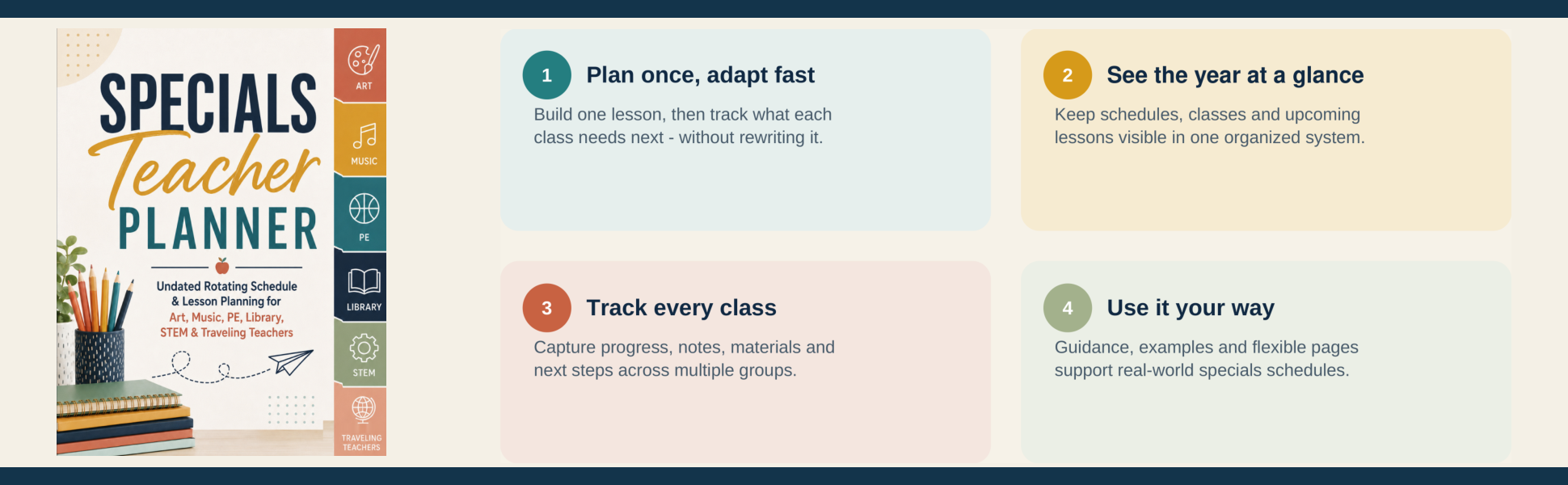
Julie Yamamoto’s Specials Teacher Planner supports this workflow with a Weekly Lesson Plan for shared instruction and a Class Progress Tracker for classes that are ahead, behind, shortened, canceled or interrupted. It also includes a Substitute Teacher Guide and a Year-at-a-Glance Curriculum section.
The planner is an undated 8.5 × 11 paperback with a color interior. See the complete sample pages and planner details to decide whether its layout fits your teaching day.